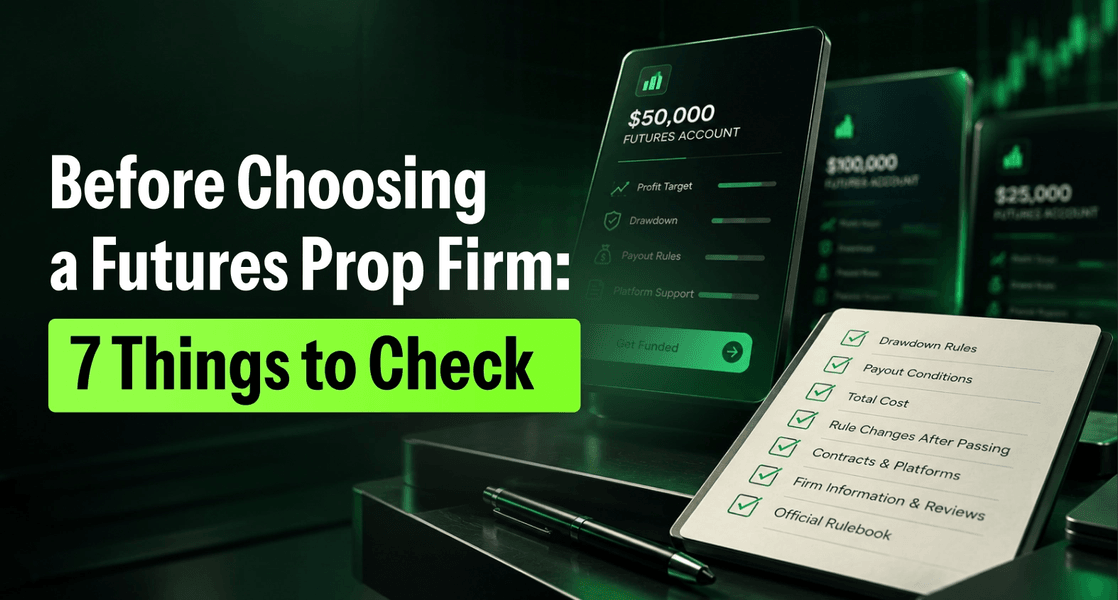
Before Choosing a Futures Prop Firm, Check These 7 Things
Choosing a futures prop firm is about more than finding the biggest account or the cheapest evaluation. If you’re comparing popular futures prop firms like Topstep, Apex Trader Funding, Take Profit Trader, Tradeify, MyFundedFutures, or FundedNext Futures, look beyond the advertised account size. Drawdown rules, payout requirements, fees, and platforms can differ between firms—and between plans at the same firm.
The right firm is the one whose rules fit how you trade and whose full cost and payout process you understand before you buy. Use this futures prop firm comparison to evaluate the exact plan you’re considering.
Quick answer: Before buying, compare the drawdown model, payout rules, total cost, funded-account changes, contract and platform support, firm information and reviews, and the official rulebook. Check the exact plan you intend to trade: rules can differ between plans at the same firm.
1. Understand how the drawdown works
Drawdown is one of the most important futures prop firm rules. It sets the loss limit that can close your account, but firms calculate and update that limit in different ways.
Common models include:
- Static drawdown: The loss threshold stays at a fixed level.
- End-of-day trailing drawdown: The threshold may move based on the firm’s end-of-day calculation.
- Intraday trailing drawdown: The threshold may move during the trading session, sometimes based on unrealized gains.
The labels alone don’t tell you exactly how a rule works. Before choosing a plan, check:
- Is the drawdown based on balance, equity, or both?
- When does the threshold move?
- Does it follow unrealized profit?
- Does the threshold eventually stop trailing?
- What happens to the threshold after a payout?
Example: A trader who regularly sees open profit pull back before the session closes may find an intraday trailing limit behaves very differently from an end-of-day limit. The best fit depends on the trader’s strategy and the firm’s exact calculation.
CME explains that futures contract tick sizes and dollar values differ by instrument, so your contract and position size also affect how quickly losses can use your available drawdown.
2. Read the payout rules before you focus on the profit split
A headline profit split doesn’t tell you when you can request a payout or how much you can withdraw. Futures prop firm payout rules may include:
- A minimum number of trading or winning days
- A consistency requirement
- A minimum account balance or payout buffer
- Minimum or maximum withdrawal amounts
- A payout schedule or waiting period
- Different rules after previous withdrawals
Example: Topstep’s current payout policy says Express Funded Account traders using its consistency path must meet a three-trading-day requirement and a 40% consistency target before requesting a payout. That is one firm’s current rule; other firms and account types may use different conditions.
Ask yourself: Can I follow these payout conditions while trading my usual plan? If not, the advertised split or payout speed may matter less than it first appears.
3. Calculate the full cost, not just the entry price
The price shown in a promotion may be only one part of what you could pay. Depending on the firm and account, your costs may include:
- Evaluation or subscription fees
- Resets or additional attempts
- Activation fees after passing
- Platform, data, or exchange fees
- Fees that recur over time
A useful comparison is:
Potential total cost = evaluation fees + resets or repeat attempts + activation fee + required platform or data fees
Not every fee applies to every firm. Check the checkout page and rules for the exact plan before purchasing. For example, Apex Trader Funding’s current help center says eligible evaluations have a seven-calendar-day window to pay the activation fee after passing. Check which product you’re comparing, since fees and terms can differ.
A low promotional price can still be a poor fit if the account has rules that conflict with your strategy or additional costs you hadn’t budgeted for.
4. Check whether the rules change after you pass
Passing an evaluation does not always mean you continue under the same conditions. A firm may change the drawdown model, position limits, payout requirements, or other rules when you move to a funded stage.
Before buying, map the whole path:
- What rules apply during evaluation?
- What rules apply immediately after passing?
- What changes after a payout?
- Can the account move to a different program or live stage?
- What happens if the account breaches a rule?
If you’re comparing Topstep, Apex Trader Funding, Take Profit Trader, Tradeify, or another futures prop firm, check the specific account plan and each stage. “Same firm” does not mean “same rules.”
5. Confirm your contracts and trading platform are supported
A futures prop firm may support some platforms and instruments but not others. Check that the exact account supports the products and tools you rely on, such as:
- Your preferred contracts, including micros if you use them
- Your trading platform and data connection
- Your usual order types
- Copy trading or multiple-account workflows, if relevant
- Any automation tools you use, if permitted
Don’t assume a platform is available for every plan just because the firm supports it somewhere. Confirm the connection, fees, and restrictions for the account you want.
6. Look at firm information and trader feedback carefully
Trader reviews can help you spot questions to investigate, especially around support, platform reliability, and payout experiences. But a rating by itself cannot tell you whether a plan fits your trading style, and individual reviews are not a guarantee of what will happen to you.
Use reviews as one part of your research:
- Look for recent, detailed experiences rather than relying only on an overall score.
- Notice whether reviewers describe the plan and account stage they used.
- Compare positive and negative feedback.
- Check important claims against the firm’s current official rules.
- Treat dramatic claims as prompts to investigate, not as proof by themselves.
Also check how long the firm has operated and whether its current rules and company information are easy to find. Those details can help you judge what you still need to verify.
7. How to compare futures prop firms: verify the official rules
Comparison pages are useful for building a shortlist, but firms can update prices and rules. Before purchasing, verify the details directly with the firm.
Check the official information for:
- The exact account plan and size
- Current evaluation price and promotion terms
- Drawdown calculation
- Daily loss limit, if any
- Consistency and payout requirements
- Activation, reset, and recurring fees
- Platform, contract, and trading restrictions
Save or note the date you checked the rules. If something is unclear, ask the firm’s support team to explain it before you pay.
A quick checklist before you buy
Before choosing a futures prop firm, make sure you can answer:
- What is the drawdown model, and when does its threshold move?
- What conditions must I meet before I can request a payout?
- What is the full cost if I need another attempt or pass the evaluation?
- Do the rules change after I pass or request a payout?
- Does this exact plan support my contracts and platform?
- Have I looked at recent trader feedback and checked the firm’s official terms?
- Can I explain the rules in my own words before trading the account?
If you’re unsure about any of these, pause and check before buying. Understanding the rules in advance can help you avoid choosing an account that doesn’t match how you trade.
Compare futures prop firms side by side
Once you know what matters to you, compare plans using the same criteria: total cost, drawdown, payout conditions, platforms, and trading rules. Prop Firm Genie’s Head-to-Head comparison tool lets you choose two firms, account types, and sizes, then compare available details such as pricing, drawdown, profit split, evaluation rules, payout frequency, contracts, and platforms. Check the firm’s official rules before making a purchase.
Which rule matters most when you choose a futures prop firm: drawdown, payout conditions, or total cost? Share your answer with the trading community, and use the comparison tool to see how your shortlisted plans differ.